Undead Labor Trade
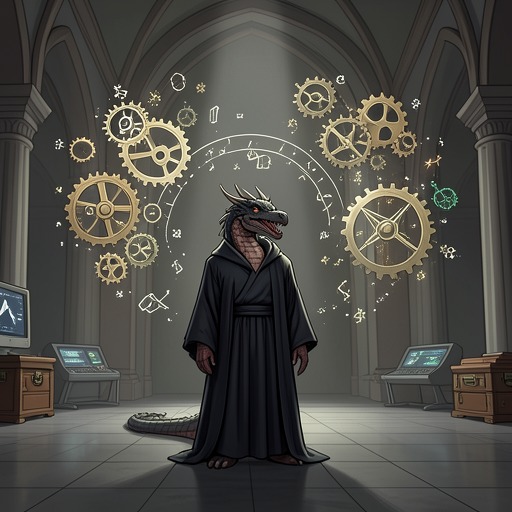
Vainqueur the DragonUndead Labor Trade is the commercial system of purchasing corpses from living relatives, transforming them into mindless undead, and assigning them to productive labor. Presented as a newly developing industry rather than an ancient custom, it links necromancy to contracts, fees, urban charters, imperial policy, and the expansionist ambitions of the Empire of Murmurin. Its promise of tireless workers makes it attractive to Vainqueur Knightsbane, while its treatment of the dead as exploitable labor reveals the moral and political costs hidden beneath its claims of efficiency.
Definition and Operating Model
The trade begins with a transaction between the living and a necromantic institution. Relatives sell or surrender corpses, authorize their postmortem transformation through a binding legal agreement, and receive payment in return. The resulting undead are mindless workers assigned to tasks ranging from mining to farming. The system therefore treats death not as the end of a person's economic usefulness but as a change in labor status: the body becomes a durable productive asset, while the living relative becomes the legally recognized party empowered to dispose of it.
Its advocates describe this arrangement as both practical and humane. The necromancer who explains the industry argues that animated corpses have no feelings and therefore suffer less than living animals subjected to slavery. The same defense presents undead labor as a public benefit, imagining zombies cultivating fields in every town from Midgard to Ishfania and fearless skeletons rescuing orphans from forest fires. The rhetoric turns exploitation into social utility, using safety, productivity, and the absence of undead emotion to claim that the industry improves the lives of the living.
The legality of the trade is presented as conditional rather than universal. It is described as a perfectly legal new industry, but only a very small number of cities currently permit it in their charters. Its supporters consequently seek institutional expansion: once towns recognize the advantages of enslaving the dead for the benefit of the living, they are expected to amend their laws and admit the practice. The industry’s growth thus depends not only on necromantic technique but also on persuading governments to convert a controversial exception into ordinary civic infrastructure.
Commercialization and the Corpses of War
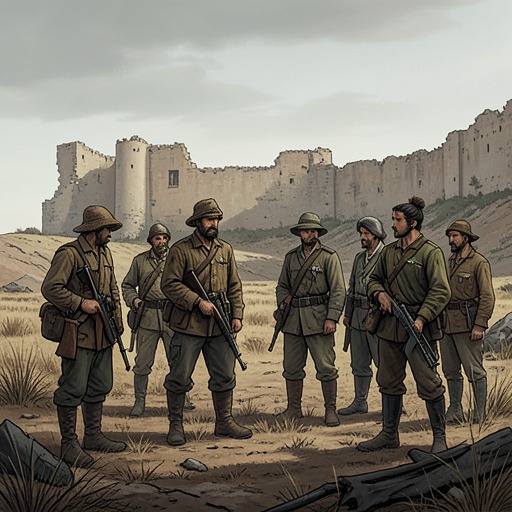
The trade becomes concrete when Vainqueur Knightsbane considers what to do with corpses and monster remains that would otherwise be discarded. Victor Dalton explains that such bodies are simply left for animals to eat. Vainqueur rejects that wasteful practice and orders Victor to find a way to make money from it, directing him toward a shop selling junk, monster parts, and corpses. Undead Labor Trade is therefore connected to a broader enterprise in which the remains of defeated creatures are extracted, classified, and resold rather than allowed to disappear from the economy.
A necromancer offers a precise schedule of payment: fifty gold pieces for an ordinary corpse and five hundred for the Manticore, for a stated total of eight hundred gold pieces. The transaction requires Victor, acting as the relevant living relative, to sign a long contract swearing before the gods that he consents to the corpses’ necromantic transformation. Victor understands the legal act as the sale of corpses for postmortem slave labor and feels that the arrangement is morally dirty. Vainqueur, by contrast, measures the exchange by the growth of his hoard and treats the fee as proof that a troubling practice can be made profitable.
The episode also exposes the unequal distribution of value inside the trade. Vainqueur promises Victor a share, but when the payment arrives he gives his chief of staff eight gold coins and corrects Victor’s expectation that the amount would be one-tenth of the sales by insisting on “One one-tenth.” The joke is characteristic of the system’s larger logic: apparently precise contracts and commercial language do not prevent the powerful party from controlling interpretation. Undead Labor Trade formalizes the dead as commodities, but it also reinforces hierarchy among the living who arrange the sale.
Religious and Institutional Legitimacy
The industry is promoted through a religious economy in which churches, priests, and goddesses provide services for fees, donations, and contractual exchange. The necromancer associated with the church of Camilla presents undead labor as a legitimate economic development and attacks attempts to restrict it as opposition from bourgeois noble imperialists to free undead enterprise. His argument makes the church more than a spiritual authority: it is a broker, legal intermediary, ideological defender, and supplier of transformed labor.
This legitimacy remains unstable even within the divine marketplace. The priestess of Shesha warns that Shesha herself is uncertain whether the long-term consequences of mass necromancy justify the additional market value. The warning introduces a limit that the industry’s sales pitch tries to suppress. Its advocates claim that there is no proof necromantic energy harms the environment, but the goddess’s hesitation indicates that profitability has outrun knowledge. The trade is not simply opposed by moral conservatives; its own supernatural institutions recognize that large-scale expansion may produce consequences that cannot be priced in advance.
The same market-centered religious world frames resurrection and afterlife as negotiable services. When Victor later faces competing claims on his soul, Camilla offers an afterlife proposal in recognition of his exemplary service to the undeathstrial revolution and his continued friendliness toward her church. Shesha, meanwhile, reveals that mortals paid a generous church donation for Victor’s revival on Outremonde. These transactions broaden Undead Labor Trade beyond corpse disposal: necromantic labor, resurrection, spiritual allegiance, and divine favor all become parts of an economy in which service generates claims and payment purchases intervention.
Expansion Under the Empire of Murmurin
The industry acquires a political future through the Empire of Murmurin. Jules Rapace, a corpseling who joins Vainqueur’s organization, explains that he was attracted by a country lacking Gardemagne’s heavy taxation on undead labor and open to the idea of mass zombification. He anticipates a great corpse boom and hopes that the Empire of Murmurin will initiate the “undeathstrial revolution” he dreams of. His language treats a change in the status of the dead as an industrial breakthrough comparable to a new economic age.
Jules’s ambitions fit Vainqueur’s governing instincts. Vainqueur is interested in the funds the business might generate, while the empire offers a comparatively permissive legal and fiscal environment in which necromantic production can expand. The arrangement joins entrepreneurial migration to state formation: a specialist seeks a jurisdiction favorable to his industry, and an emerging empire gains an activity capable of supplying labor, attracting experts, and differentiating its laws from those of Gardemagne.
Vainqueur eventually declares that all creatures who die in his service will be reanimated to work as sentient undead, following the example of the Kobold Rangers. He frames this as continuity of employment rather than a termination of service, insisting that death should not end a fulfilling job and that subjects should serve him in death as well as in life. Victor objects that he does not raise thinking undead for ethical reasons and asks for an exception, but the declaration reveals the imperial scale of the concept: Undead Labor Trade has moved from a private sale of corpses to a standing policy governing the afterlife of an entire workforce.
Labor, Loyalty, and the Meaning of Service
The industry’s central promise is that undead workers are exceptionally convenient. Vainqueur values them because they do not flee, do not eat, are not tempted by a hoard, and live almost as long as dragons. Their appeal lies in the removal of ordinary labor relations: hunger, fear, desire, mortality, and bargaining power are all treated as inefficiencies. What appears to be a perfect workforce is therefore a workforce stripped of the conditions that might allow workers to refuse service.
That logic mirrors Vainqueur’s treatment of his living minions. He loans Victor wearable treasures while presenting the arrangement as boundless generosity, expects gratitude in return, and later describes Victor’s position as both prized chief of staff and debtor. He also loans weapons from his hoard to the Kobold Rangers, but only temporarily, because he dislikes spreading his treasures beyond his sight; Victor alone is considered trustworthy enough to wield the sacred items in battle. Across these exchanges, service is organized through gifts, loans, debt, and surveillance. Undead labor makes the pattern literal by ensuring that service survives the worker’s death.
The concept also transforms loyalty into an accounting mechanism. After Victor’s revival, Vainqueur declares that Victor owes him more than twelve million gold coins, added to the life debt incurred when the dragon raised him as chief of staff. Victor accepts the debt with uneasy calm and resolves to find a way to repay it. The commercial language surrounding resurrection clarifies why the undead industry matters thematically: once life and death can be priced, continued service becomes a creditor’s claim rather than a purely personal bond.
Narrative Significance
Undead Labor Trade functions as one of the book’s clearest examples of institutional satire. Its proponents use the vocabulary of legality, safety, environmental proof, market freedom, and industrial progress to defend the conversion of corpses into labor. At the same time, the narrative places those arguments beside Victor’s discomfort, Shesha’s uncertainty, and Vainqueur’s undisguised delight in profit. The result is not a simple condemnation or endorsement. The industry is absurdly efficient, politically inventive, and materially useful precisely because it makes exploitation appear administratively clean.
Its development also shows how the world’s organizations compete to capture value from death. Churches supply miracles and transformations; relatives authorize transactions; necromancers provide technical expertise; cities decide whether charters permit the practice; imperial governments offer favorable jurisdictions; and rulers such as Vainqueur absorb the resulting workers into armies and public service. No single institution controls the system, but every institution can profit from its expansion.
The industry’s final irony is that it promises to abolish waste while preserving domination. Corpses no longer rot unused, workers no longer stop at death, and the empire can imagine farms, mines, and rescue crews staffed by tireless undead. Yet the very features that make the workforce attractive are the features that erase consent and vulnerability. Undead Labor Trade therefore marks the point where Vainqueur Knightsbane’s hoard-centered opportunism, Victor Dalton’s reluctant administrative labor, religious commerce, and imperial ambition converge in one grotesquely coherent economic project.